Kasetsart University Sriracha Campus recognizes its responsibility to society as an educational institution supporting human resource development in the Eastern Seaboard region. Accordingly, the campus developed academic programs aligned with regional needs. At the graduate level, the Kasetsart University Council, in its 4th meeting of 2003 on April 21, approved the opening of two graduate programs starting from the first semester of academic year 2003:
•Master of Economics Program in Business Economics (MBE)
•Master of Arts Program in Agribusiness (MAB)
(Renamed Master of Science Program in Agribusiness for students admitted from the first semester of academic year 2012 onwards)
Both programs were originally offered at the Bangkhen Campus. Initially, program administration was under two special program committees:
1.Executive Committee of the Graduate Program
2.Project Operation Committee
In order to enhance the management of education and curriculum development at Sriracha Campus through the effective utilization of shared resources and in alignment with the University’s objectives, the Kasetsart University Council approved the establishment of the Graduate School as an academic unit of Sriracha Campus, with a status equivalent to that of a faculty. The Graduate School was responsible for the Special Program Master’s Degree in Business Economics and the Special Program Master’s Degree in Agricultural Business, effective from September 15, 2004.
Subsequently, the unit was granted approval to change its name to the Graduate School of Sriracha on September 24, 2007. Later, during the 12th meeting of 2010, held on December 27, 2010, the Kasetsart University Council approved the restructuring and renaming of the Graduate School of Sriracha to the Faculty of Economics, Sriracha Campus. This transformation aimed to reflect the faculty’s actual responsibilities, as well as to enable its continuous development and expansion of academic functions. The official change took effect on February 3, 2011.
The Faculty of Economics, Sriracha Campus, is organized into three divisions:
1. Office of the Secretary
2. Division of Academic Affairs
3. Research and Academic Services Center
Additionally, the Bachelor of Economics Program has been launched since the first semester of the academic year 2011.
Subsequently, in order to ensure the effective administration of the Faculty of Economics, Sriracha Campus—particularly in terms of personnel management, resources, and budget allocation—while maintaining flexibility, clarity, and alignment with current missions and operations, as well as in accordance with Kasetsart University’s policy on the development of the educational system and Academic Departments, which required faculties and colleges without departmental divisions to restructure accordingly, the Kasetsart University Council, in its 8th meeting of 2014 (August 25, 2014), approved the reorganization of the Faculty of Economics, Sriracha Campus, as follows:
1. Office of the Secretary
2. Department of Economics
3. Department of Applied Economics
4. Research and Academic Services Center (with a status equivalent to that of a department)
5. The Division of Academic Affairs was dissolved, and the Dean of the Faculty of Economics at Sriracha was assigned to transferred the responsibilities, personnel, assets, liabilities, and other related matters to the relevant departments under the Faculty of Economics, Sriracha Campus.
However, since the Research and Academic Services Center had no permanent personnel, resources, budget, or ongoing projects, and in order to streamline administration, establish an organizational structure appropriate to current operations, and promote efficient resource utilization, the Kasetsart University Council, in its 2nd meeting of 2015 (Monday February 23, 2015), resolved to dissolve the Research and Academic Services Center. Its functions related to research and academic services were transferred to the Office of the Secretary, Faculty of Economics at Sriracha.
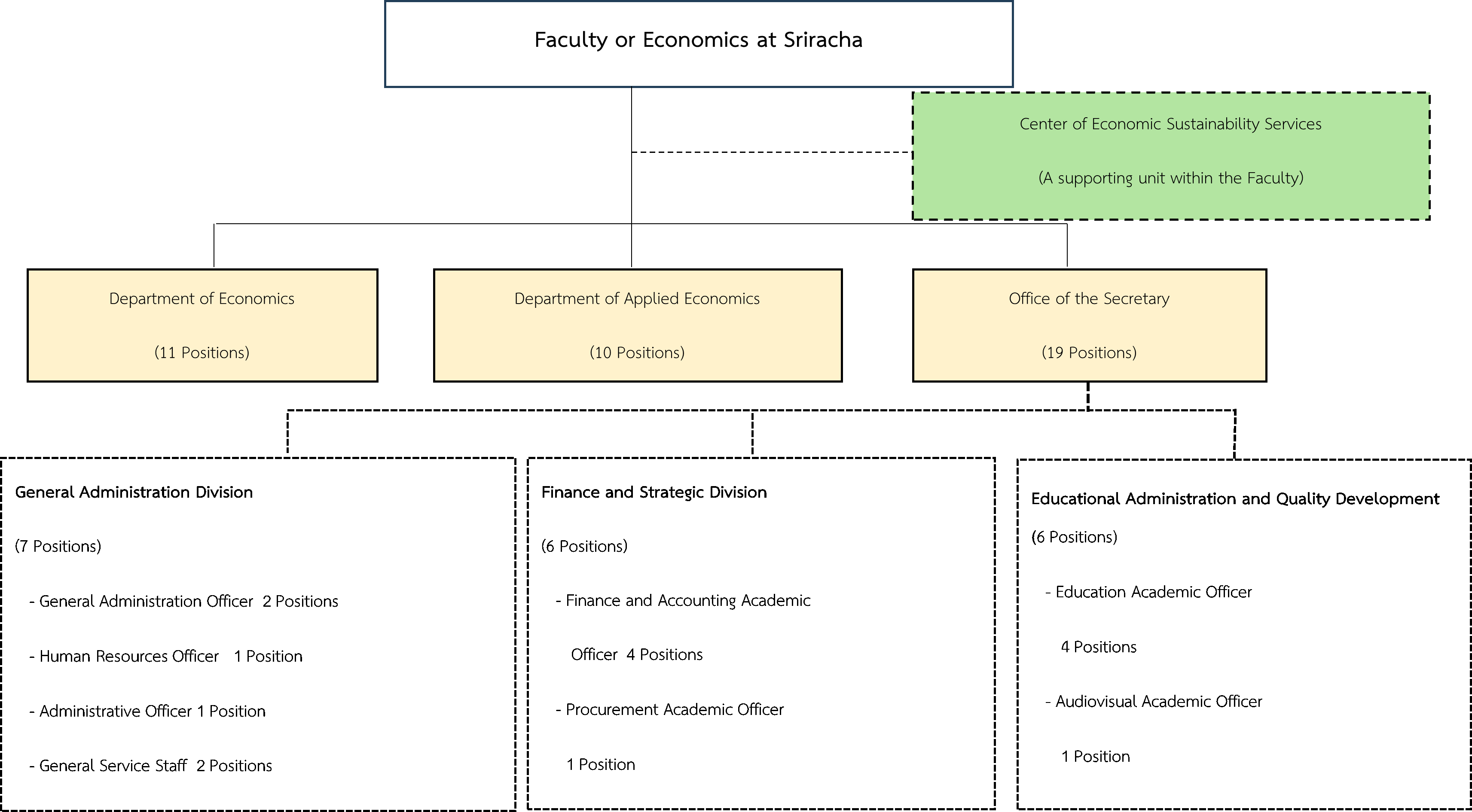
So as to further enhance the efficiency and clarity of administrative operations within the Faculty of Economics at Sriracha—particularly in terms of personnel management to ensure consistency with its current missions and functions—the Kasetsart University Council, in its 9th meeting of 2024 (September 30, 2024), resolved to designate the internal organizational structure of the Faculty of Economics at Sriracha, as follows:
1. Office of the Secretary, comprising:
1.1 General Administration Section
1.2 Educational Administration and Quality Development Section
1.3 Finance and Strategic Planning Section
2. Departments, comprising:
2.1 Department of Economics
2.2 Department of Applied Economics
3. Establishment of the Academic Center for Economics Sustainability (ACES) as an integrative unit under the Faculty of Economics at Sriracha.
Vision
To integrate international-level economics knowledge and cultivate high-quality individuals with creativity for the sustainable development of the economy and society.
Mission
1.Develop competent graduates capable of applying economic knowledge for sustainable development, recognized by the global labor market
2.Produce research and academic services in applied economics that promote sustainable development
3.Build networks and collaborations with public and private sectors to support lifelong learning
4.Foster a productive work environment through holistic skill development and effective governance
Core Values
PASA-E (Expanded from the Sriracha Campus core values)
P – Personal Mastery and Innovation Mind
A – Adaptability
S – Synergy
A – Altruism and Stakeholder Focus
E – Economics Mindset
Core Competencies
1.Faculty members can integrate economics knowledge to guide students in analysis, synthesis, and
systematic problem-solving in economic and social contexts.
2.Faculty members show genuine concern for students beyond classroom instruction.
3.Staff are eager to develop themselves in line with technological and environmental changes to enhance
their capabilities.
Uniqueness
The Faculty adopts the uniqueness of Kasetsart University:
"Kasetsart University: Promote Knowledge of the Land for the Well-being of the Nation"
Identity
Based on Identity of Kasetsart University (IDKU): "Conscience, Determination, Creativity, Unity"
Vision Indicators
1.Number of newly established academic programs aligned with the Sustainable Development Goals
(SDGs): not fewer than one program.
2.Number of academic programs accredited by international standards: not fewer than two programs
(Targeted programs: B.Econ and MBE).
3.Percentage of faculty members recognized as meeting international standards (e.g., PSF, KUPSF, UKPSF, or equivalent): not less than 80%
(Short-term target, Years 1–3: 20%; Medium-term target, Years 4–6: 50%; Long-term target, Years 7–10: 80%).
4.Percentage of graduates employed in nationally or internationally recognized institutions/organizations: not less than 25% of new graduates.
(This includes graduates who establish registered private businesses and those employed in government agencies. Baseline data are to be considered in consultation with the Office of Strategic Management.)
5.Ratio of faculty publications indexed in national (TCI Tier 1) and international databases (Q1–Q4): not less than 0.5 publication per faculty member per year
(equivalent to at least one publication per faculty member every two years).
6.Number of research or academic service projects addressing sustainability: not fewer than two projects per year.
7.Percentage increase in annual non-tuition revenue compared with the baseline year 2023: at least 10% per year.
8.Percentage of successful achievement of strategic plan indicators: not less than 80%.
Strategies
Strategy 1: Fostering and integrating Knowledge of the Land for sustainable development and social well-being.
Strategy 2: Advancing academic excellence to meet international standards.
Strategy 3: Enhancing operational systems based on the principles of good governance to strengthensustainable management capacity.
Goals
Strategy 1
1.1 To develop teaching & learning curricula and services that address the needs of sustainable development in the Eastern region and the nation.
1.2 To develop Integrate knowledge in medicine and public health into curriculum, research, and academic services
Strategic Indicators
Strategy 1
1.1 Number of newly established undergraduate programs that address sustainable development in the Eastern region, emphasizing collaboration with industry and alumni, and incorporating courses related to the SDGs: at least 1 program.
1.2 Number of revised undergraduate/graduate programs jointly developed with alumni, with courses related to the SDGs incorporated into the curriculum: at least 1 program.
1.3 Number of newly developed Joint Degree/Double Degree (Integrated Bachelor–Master Program) curricula at the graduate level, created through collaboration with faculties within the campus, local agencies, and alumni: at least 1 program.
1.4 Expansion of the Graduate Study for Potential Professionals (GSPP) project: at least 1 new course
peryear (Baseline year 2024: 5 courses offered).
1.5 Number of newly established undergraduate courses related to entrepreneurial skills, developed from the Econ non-Academic Program on entrepreneurial skills in the digital economy for sustainability: at least 1 course.
1.6 Percentage of graduates employed in target organizations (government agencies, state enterprises, private organizations meeting Global 500 or SET100 criteria, and independent entrepreneus
registered with the Department of Business Development): not less than 10%.
1.7 Number of research projects/academic service projects/courses integrating knowledge of health economics, medicine, public health, and food sciences: at least 1 project in each field.
1.8 Number of training programs provided for the working-age population and/or the elderly in the community for Upskilling/Reskilling/New skills, with at least 30 participants per program, across 3 programs.
1.9 Number of projects supporting student start-up creation: at least one project, and number of external awards received by student teams: at least 1 team.
1.10 Number of projects in which faculty members participate as consultants in economics/investment for industry and in conducting economic, social, and environmental impact assessments: at least 2 projects.
Strategy 2
2.1 Number of courses taught in English: 6 courses.
2.2 Number of programs accredited under AUN-QA (ASEAN University Network – Quality Assurance) standards: 2 programs.
2.3 Number of faculty members/students receiving international standard certifications or awards: 1 award per year.
2.4 Ratio of faculty publications at national and international levels: 0.5 publication per person per year.
2.5 Number of research outputs from international research collaborations: 1 output.
2.6 TOEIC scores of faculty and staff: not less than 700 for academic staff and not less than 500 for supporting staff.
2.7 Number of international databases in which the Faculty’s academic journal is indexed/recognized: 1 database.
2.8 Number of times organizing/co-organizing international academic conferences or forums for dissemination of research: once.
Strategy 3
3.1 EdPEx assessment results: not less than 200 points within 4 years.
3.2 Increase in revenue from academic services: at least 10% annually compared to the previous year.
3.3 Increase in revenue from other activities (alumni homecoming events, space rental): at least 3%
annually compared to the previous year.
3.4 Number of academic works (operational manuals, institutional research, analytical/synthetic works): 2 works per year.